Academic Division 01

Mathematical, Physical & Chemical Sciences

Advancing fundamental understanding of quantity, structure, matter, energy, and the laws that shape the natural world.

01 / 08
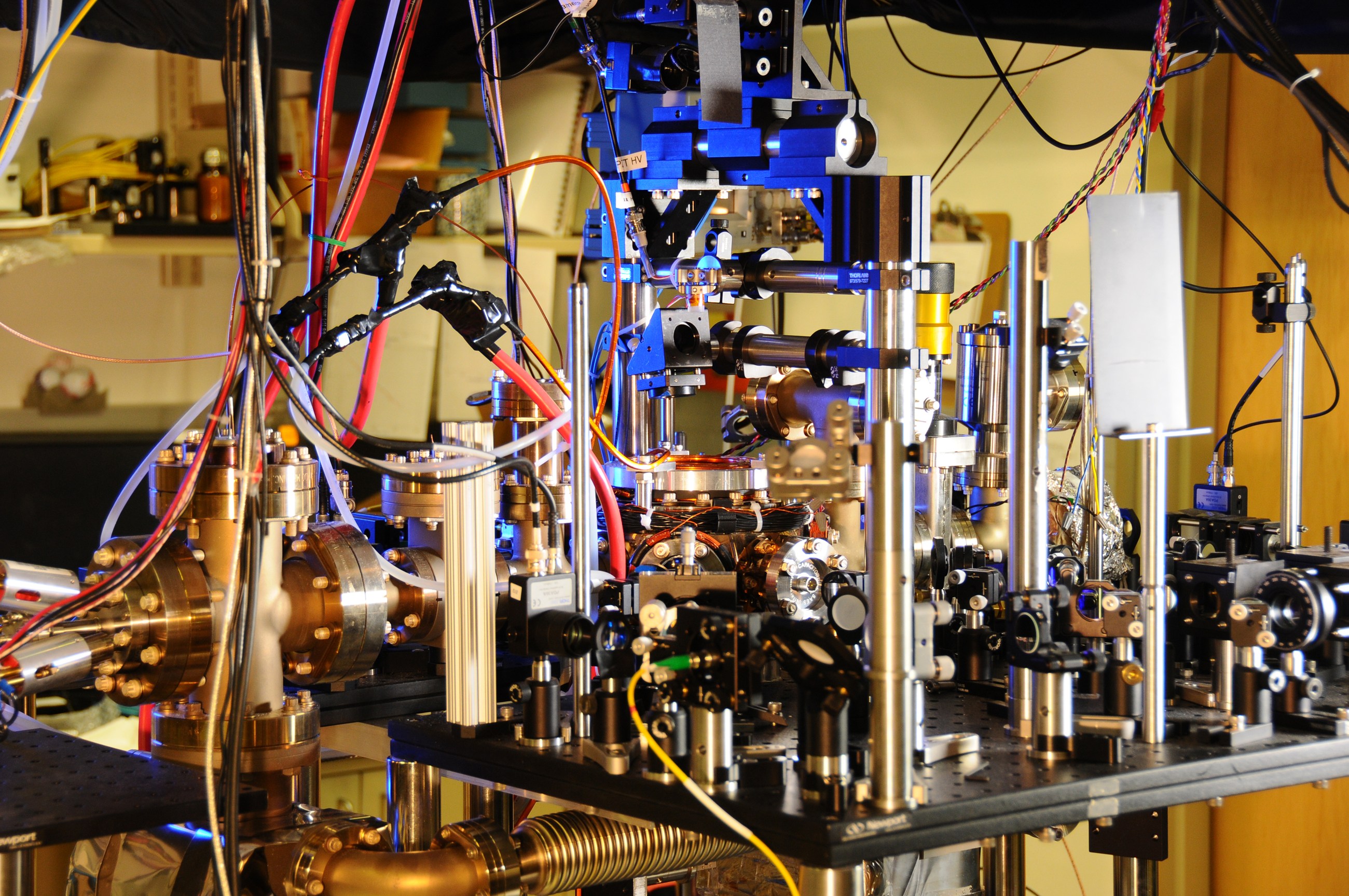
The vacuum chamber, optical components and fibres of a NIST ytterbium lattice atomic clock.

This division spans pure and applied mathematics, theoretical and experimental physics, chemistry, astronomy, materials science, and the computational methods that connect them. It values foundational discovery alongside work that opens new pathways in technology, health, energy, and environmental understanding.

This division brings together the foundational sciences that describe structure, quantity, matter, energy, and change. Its intellectual territory extends from abstract proof and theoretical models to precision measurement, experimental systems, astronomical observation, materials, and computation. The division treats mathematics, physics, and chemistry as distinct disciplines with their own standards, while recognizing that many advances emerge at their boundaries. It encourages long-horizon inquiry as well as work that strengthens scientific capacity, instrumentation, data quality, and research collaboration across Latin America. Reproducibility, transparent uncertainty, and careful separation between observation, model, and inference are central to its scholarly culture.

Fields and scholarly sections

A broad disciplinary home with clear centres of expertise

Pure and applied mathematicsPhysics and astronomyChemistry and molecular scienceMaterials and condensed matterStatistics and probabilityComputational sciencePhotonics and quantum scienceComplex systems
Scope and intellectual field

A disciplinary home broad enough for discovery and precise enough for judgment

This division spans pure and applied mathematics, theoretical and experimental physics, chemistry, astronomy, materials science, and the computational methods that connect them. It values foundational discovery alongside work that opens new pathways in technology, health, energy, and environmental understanding.

Within Mathematical, Physical & Chemical Sciences, fields such as Pure and applied mathematics, Physics and astronomy, Chemistry and molecular science, Materials and condensed matter are treated as connected areas of inquiry rather than isolated labels. The division gives specialists a recognizable home while making room for new combinations of theory, observation, experiment, computation, design, interpretation, and professional practice. Its role is not to prescribe one intellectual school, but to make standards of competence visible and to ensure that interdisciplinary work remains answerable to the disciplines on which it relies.

Research design and evidence

Questions determine methods and claims remain proportionate to evidence

A serious research programme begins by defining the object of inquiry, the relevant scale, the state of existing knowledge, and the form of evidence capable of changing a conclusion. Depending on the field, that may require experiments, longitudinal observation, archival interpretation, mathematical modelling, fieldwork, qualitative inquiry, engineering validation, comparative analysis, or a deliberate combination of approaches. The division expects methods to be described clearly enough for informed scrutiny and limitations to remain visible throughout interpretation and communication.

Research connected to Latin America should also explain place, history, institutions, language, ecology, and unequal access where these conditions shape the evidence. Regional relevance does not lower disciplinary standards; it often requires more exact contextual reasoning. Comparative or international work should identify what can legitimately be generalized, what remains specific, whose knowledge is represented, and how data, credit, responsibility, and long-term stewardship are distributed among collaborators.

Contribution across the Academy

Deep expertise becomes more useful when its boundaries and connections are understood

It supplies the Academy with rigorous quantitative frameworks, experimental precision, and a shared language for discovery across disciplines.

Across the Academy, the division can convene peer review, identify reliable expertise, formulate research questions, mentor emerging scholars, and test the disciplinary foundations of shared projects. It may contribute to evidence reviews, methods notes, comparative studies, scholarly dialogues, or carefully governed public explanations. Any output should name its authors and reviewers, state the route by which it was developed, distinguish consensus from disagreement, and avoid suggesting institutional authority beyond the mandate actually granted.

Questions shaping the scholarly agenda

The division advances through questions that connect discovery evidence and consequence

Which mathematical structures and computational ideas can reveal patterns that observation alone cannot expose?

How do matter and energy behave across scales, from quantum systems to complex materials and the cosmos?

How can measurement, standards, and instrumentation increase the reliability and comparability of scientific evidence?

How should models represent uncertainty, emergence, nonlinearity, and the limits of prediction?

Research practice and standards

Methods must be appropriate evidence must be inspectable and limits must remain visible

The division supports methodological pluralism within rigorous disciplinary standards. Choice of method should follow the research question; claims should remain proportionate to evidence; and collaboration should make responsibilities, data stewardship, authorship, uncertainty, and conflicts of interest explicit.

Methods and evidence

  • Proof, theory, and formal reasoning
  • Laboratory experiment, spectroscopy, and metrology
  • Scientific computing, simulation, and open numerical methods
  • Observational programmes, uncertainty analysis, and independent replication

Connections across the Academy

  • Materials, energy, and engineering systems
  • Measurement, imaging, and quantitative health sciences
  • Climate models, Earth observation, and complex systems
  • Statistics, algorithms, and trustworthy digital technologies
Contribution to the Academy

It supplies the Academy with rigorous quantitative frameworks, experimental precision, and a shared language for discovery across disciplines.

See the Academy’s shared research priorities

In depth

From an elegant idea to a defensible explanation

A useful foundational question identifies what remains unexplained even when a calculation works. Does a mathematical result depend on an assumption that can be weakened? Can two physical models make the same predictions while proposing different mechanisms? Which molecular features account for a material's behaviour, and which merely accompany it? Such questions distinguish a description that fits available observations from an explanation that survives new situations and more demanding tests.

Different forms of reasoning answer different parts of these problems. A proof establishes a conclusion within stated definitions and premises; an experiment tests claims about a particular physical system. Numerical exploration can suggest a conjecture or reveal a neglected regime, but its reliability depends on approximation, precision, and implementation. Productive dialogue begins by making these distinctions explicit, so that analytical elegance, empirical adequacy, and computational performance can each be evaluated on their own terms.

Read the complete essay